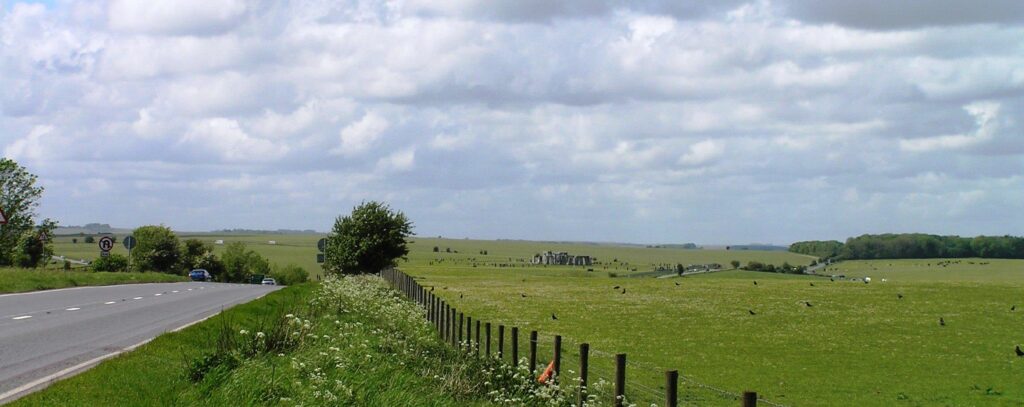
View of Stonehenge from the A303 travelling west from Amesbury Image credit: Kate Fielden/Stonehenge Alliance
In a period of climate turmoil and economic transition, sustainable transport measures are more fitting than gouging a concrete trench and tunnel through a prehistoric “landscape without parallel”.
Wiltshire Highways Authority needs to think long term, and take firm steps so that Stonehenge becomes a world leader in best practice in low carbon and demand management solutions for World Heritage Sites and other protected landscapes.
Whilst we do not put ourselves forward as advocates of any specific intervention, we list examples of local measures that would cost a fraction of the budget saved from cancelling the Stonehenge road scheme:
- Lay ultra-quiet surfacing to reduce intrusive road noise.
- Instal traffic management measures in the local villages to deter through traffic, restrict speeds to improve safety for local residents.
- Reclaim an inclusive solution for car free public access and enhanced enjoyment of the monument on foot, by bicycle and local bus. Of immediate priority to address are pedestrian and cycle routes from Amesbury to Stonehenge as well as increased frequency of bus services from Amesbury, Salisbury and Devizes (home of Wiltshire Museum).
- An underpass for cyclists and walkers was promised when the old A344 was closed to traffic and became a permissive path in 2013. This was never built. A possible alternative for non motorised traffic is the A303 agricultural underpass adjacent to Vespasian’s Camp: this should be considered as a cycleway and footpath from Salisbury to Stonehenge through stunning landscape.
- Consider potential solutions to ‘rubber necking’ near Stonehenge Bottom by trialling a landscape sensitive visual barrier e.g. camouflage fabric screen.
- Reduce the impact and severity of congestion through variable speed limits so that traffic flows smoothly between the two roundabouts either side of Stonehenge.
- Innovative methods to discourage peak tourist travel times which could generate green travel funds for connecting shuttle buses by, for instance:
- Increasing car park charges for all Stonehenge visitors (currently £4 for non-English Heritage/National Trust members, members enjoy free entry) at peak times to generate income directed towards green travel funds (e.g. shuttle buses to Amesbury);
- If Government introduces a road charging scheme, Wiltshire could propose Stonehenge as a site for piloting peak time road user charging.
- Promote green tourism packages to the south west.
- Invest in rail improvements through Wiltshire to the south west along the lines proposed by Peninsula Transport and others. See Connecting South West England: In place of A303/A358 widening